

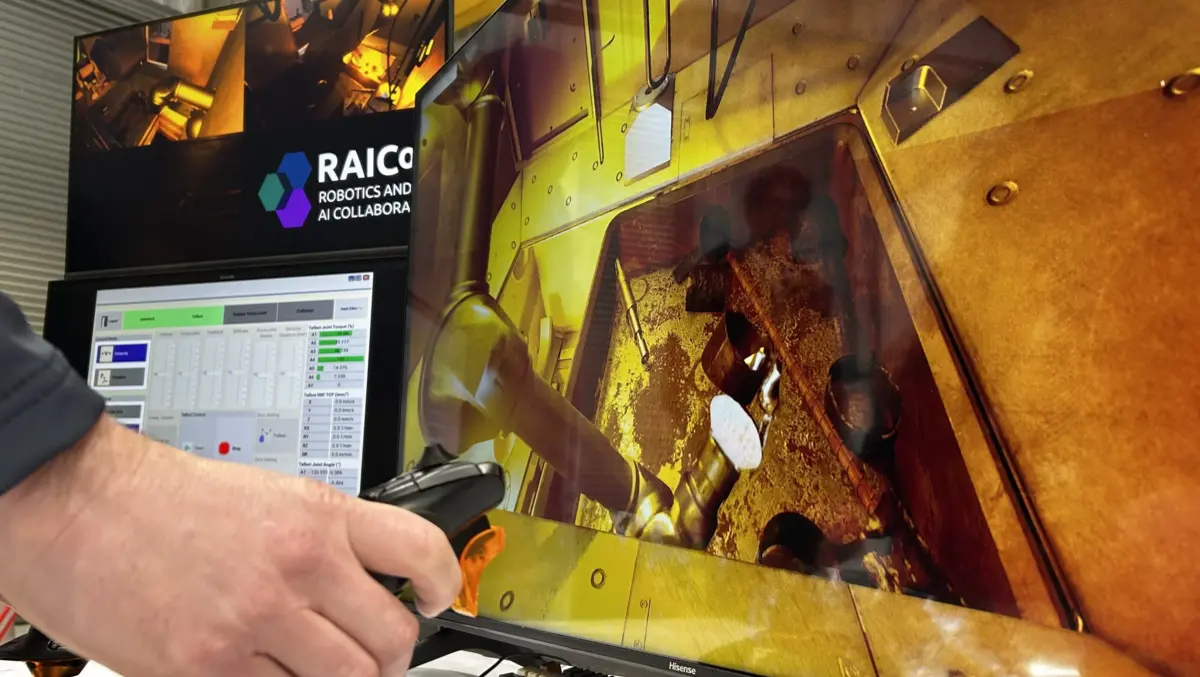

RAICo (The Robotics and AI Collaboration) has developed a software framework for simulator-based remote handling training in nuclear decommissioning. The platform is designed to let operators create their own training programmes without coding expertise.
The system is intended for environments where robots are used for remote handling in hazardous settings such as hot cells and gloveboxes. Simulator-based training can help organisations train staff at scale without exposing them to risk or taking live systems out of service.
Until now, these training programmes have often been built case by case by software specialists, making them time-consuming to create and difficult to update when operational needs change.
The new framework aims to shift that work closer to end users. Operators can load a simulated environment, build a scenario by dragging and dropping items from a library of virtual objects, and set task conditions through a simplified interface.
A training module could involve a virtual robot arm picking up a waste item, sorting it by type and placing it in a posting tray for removal from a cell. Users can create setups inside existing simulators to reflect specific use cases, including adding objects such as samples or trays and defining what counts as successful task completion.
Once configured, trainees can work through a series of tasks in the simulator while the software provides guidance and records performance data. Those metrics can then be used to assess progress and adjust the training programme.
Faster setup
James Boock, Project Lead at RAICo, described the reduction in setup time for training modules.
"Basic familiarisation training can be set up very quickly," Boock said.
"More complex task training like unscrewing a bolt may take additional time to create, depending on the amount of fine-tuning needed to reach the desired level of accuracy.
"That is far quicker than simulator training setups take today in the nuclear sector. Before this, software experts needed to build training programmes one by one and return for further development every time training needs changed. Now end users can design training themselves and update it iteratively as they learn more about those needs, all without any software expertise."
RAICo is a collaboration between the UK Atomic Energy Authority, the Nuclear Decommissioning Authority, Sellafield, the University of Manchester and AWE Nuclear Security Technologies. The group focuses on increasing the use of robotics and artificial intelligence in nuclear decommissioning and fusion engineering.
The framework is being introduced into Sellafield's Magnox Swarf Storage Silo simulator and the UK Atomic Energy Authority's Materials Research Facility receipt cell simulator. Work has also started on integration with the Oldbury fuel element debris sorting simulator and the Quadruped Familiarisation Tool used by several members of the collaboration.
These deployments suggest the framework is being adapted for a range of robotic tasks, from manipulator arms operating in enclosed nuclear environments to quadruped systems used for familiarisation and training. The common thread is the need to prepare operators for specialised equipment in settings where mistakes can be costly and direct access is limited.
Sellafield use
Sellafield has already invested in simulation as part of its work on remote handling robotics. The new approach could make it easier to keep training aligned with changing operational demands.
"We've invested in the MSSS simulator because effective training is fundamental to safe operations. This is particularly important when using complex and costly remote handling robotics, where operator competence and confidence are critical. By developing our own training scenarios through the RAICo collaboration, we can respond quickly to emerging needs and maximise the value of the simulator," said Idris Hussain, Robotics Equipment Programme Lead at Sellafield.
Remote handling systems are expected to remain central to major decommissioning tasks, particularly where radioactive material or confined spaces limit direct human intervention. Training has therefore become a practical bottleneck as sites seek to expand the use of robotics while maintaining safety standards and minimising downtime.
The framework addresses that issue by reducing dependence on specialist developers for every update. Instead of commissioning bespoke simulator content each time a procedure changes, operators can revise scenarios themselves as experience accumulates and site requirements evolve.
That could matter for facilities where tasks are highly specific and may need repeated adjustment as retrieval work progresses. It also reflects a wider effort across the sector to make simulation more usable as an operational tool rather than a standalone technical project.
"As retrieval operations ramp up across Sellafield, remote handling and robotic systems will play an increasingly important role in delivering our mission safely and at pace. We're continually seeking innovative ways to improve performance, and the ability to rapidly develop high-quality training as our knowledge and experience grows is a huge advantage," Hussain said.