

.webp)
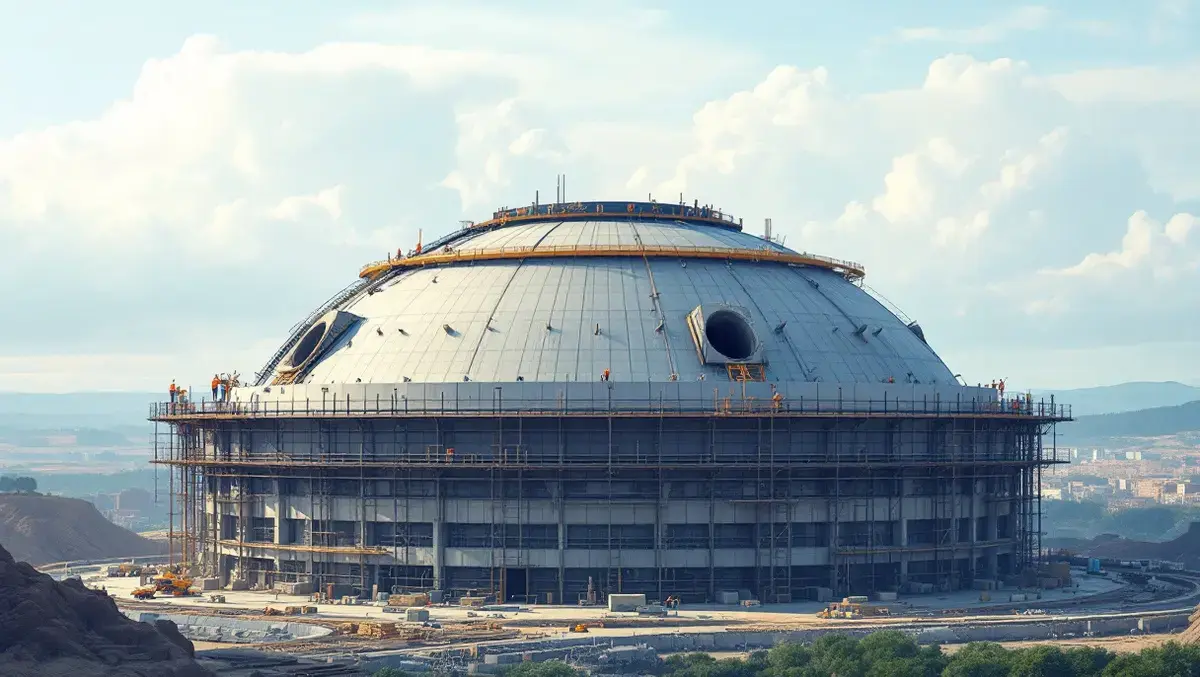
PERI UK has outlined the bespoke formwork system it designed for the reactor domes at Hinkley Point C, used on Unit 1 and adapted for Unit 2.
The work focused on one of the more technically challenging stages of the Somerset nuclear project, where concrete had to be poured for dome structures that curve in several directions. Conventional through-ties could not be used because of the reactor building's internal airtight steel shell.
PERI engineers developed a non-standard arrangement combining SCS Starter Brace, 550 Strongbacks and load-bearing SB platforms, suspended horizontally around the reactor building's perimeter. The design also used 45-degree anchor adapters to transfer concrete loads back into the structure.
The formwork operated about 45 metres above ground and had to support fresh concrete pressure, heavy equipment and live worker loads. SB platforms, more commonly used vertically for single-sided wall construction, were reconfigured into platforms about five metres wide to support the curved concrete pour.
Complex geometry
For the dome works, PERI used its VARIO formwork system and fabricated 199 bespoke panels. Earlier transition sections between the vertical reactor walls and the dome curvature used RUNDFLEX circular wall formwork panels before the work moved fully into the dome section.
The design process progressed from 2D engineering drawings to 3D CAD and digital models to map the relationship between the formwork, platforms, reinforcement and surrounding structures. PERI also built a full structural model to verify loads, connections and anchor forces because the configuration sat outside standard system parameters.
Load paths were designed so forces passed through steel RCS rails rather than the timber deck, helping the system withstand the pressure created by large concrete pours.
Dense reinforcement within the reactor walls added another constraint. Anchor positions had to be coordinated around tightly spaced rebar grids and embedded components, and some sections were redesigned on site when anchor positions deviated slightly during construction.
Lessons learned
PERI said the Unit 1 dome was completed in late 2025 and that the lessons were carried into the second reactor building. On Unit 2, the full platform solution was installed in less than 14 days.
Prefabrication supported that effort. Many elements were assembled before delivery, reducing work at height and allowing quicker installation once the equipment arrived on site.
Gabriel Constantin, Major Projects Lead at PERI UK Infrastructure, said the design had to be developed specifically for the job. "Because of this project's uniqueness, the design solution had to be created from scratch. From the onset and throughout the development of the solution, we calculated where the challenges may arise later. These initial stages were marked by, and successful because of, close collaboration and support which continued throughout implementation," he said.
The project engineer involved in the reactor building work linked the digital design process to improvements between the first and second units. "PERI's digital engineering approach not only played a key role in planning and risk reduction, particularly through rapid generation of procurement-ready kit lists, but it enabled the effective transfer of lessons learned from Unit 1 to Unit 2, directly supporting our target of achieving a 20% improvement in both time and cost," the engineer said.
Hinkley Point C has been one of the UK construction sector's largest and most complex infrastructure schemes, drawing in specialist contractors and suppliers across civil engineering, concrete, steel and mechanical systems. The reactor dome phase highlights the level of adaptation required from suppliers when standard construction methods cannot be used.
Close coordination between PERI's engineering team and the site construction team was needed throughout the work so issues could be addressed quickly. PERI also supported the site team on anchor placement and on simplifying platform installation for the mirrored configuration on Unit 2.
The same project engineer said the experience could inform later infrastructure schemes. "We believe early involvement of the supply chain will be vital in meeting future UK energy and infrastructure demands. Refining and building on proven methods from the outset, projects can achieve substantial improvements in both cost efficiency and delivery timelines. Working alongside a highly experienced reactor construction team, PERI UK's solutions are a clear benchmark. It makes complete sense to integrate these systems into future nuclear projects from the earliest planning stages," the engineer said.